.jpg)


Tattoo Lineage & History: Tobias Peltier’s Artist in Residence (In His Words)


Tattoo lineage is often talked about in terms of history, names, and timelines—but at its core, it’s built on real people, lived experiences, and the craft passed from one set of hands to the next. During his time as Artist in Residence with Mesa County Libraries, Tobias Peltier stepped outside the day-to-day rhythm of tattooing to explore that connection more deeply. What followed wasn’t just a study of tattoo history, but a personal return to the fundamentals of making, identity, and purpose within the culture.
The following is Tobias’ first-hand account of that experience, shared in his own words.
Written by Tobias Peltier — First Street Tattoo Parlor, Artist in Residence with Mesa County Libraries
I’m not typically the kind of person who enjoys the spotlight or attention, which is funny, because so much of my life puts me in it anyways - playing music, helping to orchestrate the Lowbrow Classic, and even just being a tattoo artist. It’s not to say that I don’t enjoy recognition from the work I put in; I just believe wholeheartedly in exercising humility and keeping the ego in check.
(Sidenote: Any time you see my face on social media, it’s a product of my dawg Keawe, aka Akua the God of God Division, the media guy at First Street Tattoo Parlor.)
When the opportunity to apply for Mesa County Libraries’ Artist in Residence Program presented itself, I was a little bit apprehensive. The concept of even applying for something was foreign to me. I’ve been a self-employed tattoo artist since I was 21, and before that, I just couch surfed and lived off the tiny income that comes with booking and playing punk rock shows. In August of ’25, I’d just laid my motorcycle down in a freak accident involving a deer, a hobo with a dull pocket knife, and two of my good friends. An accident like that is a very grounding experience - no pun intended. Confined to the couch and unable to move, I had nothing but time,
and that’s what pushed me to finally throw my name into the hat with the 30 or 40 other applicants. Stagnation and I aren’t really a good fit.
A few weeks later, while visiting Chattanooga, TN, for the Literary Ink Tattoo Convention, I got the call that I’d been selected to start the interview process. I was honestly shocked. I couldn’t even figure out how to get the application form to upload - what would they want me for? The day of my interview, I was a wreck. I think it’s a self-esteem issue I have: I imagine the worst-case scenario so many times and in such great detail that it derails my whole mindset. My formative years were spent in a tattoo shop around thugs and hood rats - tattooing permeates every part of me - so surely these interviewers were going to see right through me. They deal
with real artists, and I’m as unrefined of a person as they come. In my mind, their decision had already been made before I even crossed the threshold.
That absolutely wasn’t the case.
I walked into the board room to a host of smiling, encouraging faces. The team of interviewers was incredible. Instead of picking me apart like I’d imagined they would, they asked me questions about my art process, my work life, and how I came into tattooing. They made me feel like I was part of the community. All of my apprehension died in that moment. I walked away from that interview with my fingers crossed and hopeful - which, again, isn’t a very common character trait for me.
Within the hour, I received a phone call offering me the first slot of 2026, which I accepted with gratitude. They didn’t “see through me,” and they didn’t laugh me off. They saw my potential and my eagerness to contribute to something they all care for. That’s a big deal to me. It validatesmy feelings and my humanity - something I feel that street shop tattooing tends to stifle and devalue.
So there it was. I had three months to figure out what I was going to do, and for the first time in a long time, I had the space to actually think about my own movement and career, instead of the shop as a whole.


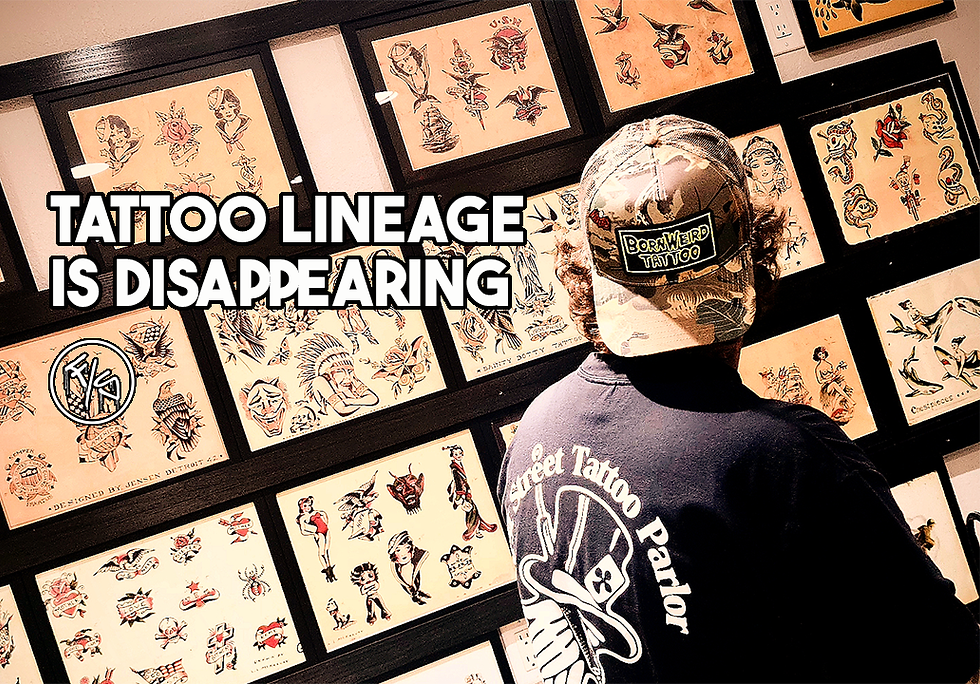
I spent most of that time sketching designs for tattoo flash. I’ve always been a super active painter, but I wanted to use this time - this gift - to really sharpen and develop some skills that would help me take my flash to the next level. I went deep: paper, paints, pens, markers—how paper is made, pH levels, how it reacts to certain pigments. I bought reference books, a mountain of supplies, and all kinds of knickknacks that I thought might help my process - huge shout out to Belzel Books, Royal Art Books, and Yellowbeak Press.
You always hear the phrase “hindsight is 20/20.” It’s funny how prepared I thought I was moving into the 970West studio in January of 2026. On day one, I looked at my mess of new supplies and my books of doodles and thought to myself, “what the fuck am I doing here?” The imposter syndrome hit hard. It took a couple of days, but the momentum built, and I got busy. The 970West Studio staff did a fantastic job of making me feel welcome and comfortable. Overall, I think I painted something like 12 or 13 sheets of flash during my tenure - no iPad, no AI, no shortcuts. Pencil, paper, pens, and paint. The way it’s been, and the way it will always be for me.

(Sidetone: someone complained to the library that my paintings were AI-generated, which prompted me to post my sketches and some progress shots. I take a lot of pride in my painting ability, and honestly, that’s the highest compliment I could have received. Thank you, anonymous complainer.)
Part of the AIR Program requirements were to be in the studio a minimum of 6 hours per week and to offer three programs that were open to the public. I got that first part sorted immediately, tailoring my work schedule so I had Wednesdays and Thursdays fully committed to studio time. I went in most Mondays as well, probably putting in 30–35 hours per week total.
The second part - that was the tough bit. How do I share tattooing with the public and actually do it justice? I didn’t want some haphazard version of the craft, something that looked like Ink Master or celebrity tattoo shows. I wanted people to understand what tattooing actually is: blue-collar, working-class art for the people. A historical record. Culture, society, and a whole lot more than what the limelight shows.
So I built the programs around that idea.
My first program was “From the Frontier to First Street.” I originally planned to trace First Street’s lineage from the early 1900s to now, but it felt incomplete. So I went all the way back - tattooing at its roots - and built a timeline forward. Ötzi, Māori, colonial exchange of knowledge,Japan, Sutherland Macdonald, the Wild West, Charlie Barrs, Bert Grimm, Lyle Tuttle, the Pike - it all connects. It took weeks to put together, but it felt like the right way to tell the story.

The second program, “The Carnival and the Cathedral,” focused on Stoney St. Clair. Most tattooers know the name, but outside of that world, he’s been largely forgotten. I dug as deep as I could - books, ephemera, anything I could find. With a blessing from Alan Govenar, we showed Stoney Knows How, and I walked people through a timeline of his life. I wanted people to see not just the work, but the man.
The third program was hands-on: tattoo stencils, specifically the lost art of cutting acetate. Using WWII as a backdrop, I talked about the motifs, the shop environments, the materials, and then let people try it themselves. By the end, everyone had sore fingers, graphite on their hands, Vaseline everywhere - but they understood something real about how this stuff was done.

Across all three talks, more than 150 people showed up. I thought my background as a touring musician would cancel out some of that stage fright, but standing there with a notebook and a PowerPoint is a different beast. Still, people came to listen and learn - not to judge. That kind of support really sticks with you and encourages you.
What is life without the simple act of community engagement? Miserable - that’s what.
Outside of the programs, my time in the studio was much quieter. When I wasn’t researching, I was painting. And somewhere in that process, something shifted. I got back to making things for the sake of making them. Not for a client. Not for a sale. Not for how it would look on skin. Just because I could. That’s probably the biggest thing I’m taking away from all of this: to create is to be human. And I think I lost that for a while. This gave it back. It took time to get there, and it’s something I’ll have to keep working at. By the end of it, I had 13 sheets of flash, sharper drawing skills, better painting habits, and a clearer understanding of why I do any of this in the first place.
The last couple weeks have been a little morose, if I’m being honest. I’m bummed it’s over. But more than that, I’ve been thinking about what comes next - how to carry this forward, how to stay open, how to keep honoring the history that got me here. The foundation for something larger is being built on this incredible experience.
There are bigger programs out there. Bigger residencies. Bigger artists. But this meant something to me. And if there’s anything worth taking from that, it’s this: don’t write something off just because it doesn’t look like it fits you. Try it. See what happens. To close out my program on Stoney St. Clair, I wrote something about welcoming the unfamiliar, checking your ego, and staying open to what’s in front of you, and I think it fits here really well.
Before that, though, some background on who he was. Stoney St. Clair contracted rheumatism as a toddler, which stunted his growth and deformed his body. He spent much of his childhood in hospitals before eventually joining the circus - first as a sword swallower, and later, after meeting Captain Coleman in Virginia, as a tattoo artist. He never let any of it stop him. If you’re curious about his story, swing by the shop. I’d be more than happy to tell it. “…thinking about Stoney’s legacy and how it matters outside of tattooing - In doing the research for this, I kept thinking about how many people have something real to contribute to the world, but never get the chance to show it. Not because they lack ability, discipline, or vision, but because someone else decided who they were before they got the chance to speak.
Preconception is quiet. It doesn’t announce itself as loudly as prejudice most of the time. It shows up as instinct - a snap read. A feeling that someone is competent or chaotic, promising or questionable. Safe, or not worth the investment. We don’t think we’re making a moral judgement - we think we’re being safe and efficient. Efficiency has the tendency to filter people out. The world doesn’t just run on systems and policies - it runs on rooms. Conversation. First impressions. Invitations. Who gets the extra 5 minutes. Who gets the benefit of the doubt. Who gets written off as “not a fit”.
Once someone is sorted into the wrong category, friction compounds. Fewer chances, less patience, tighter scrutiny, smaller margins for error. We’re not being dramatic - that’s just life. Eventually contribution dries up - not because it wasn’t there, but because there was no more room for oxygen. It was stifled.
Every person you pass is carrying a life as dense, as complicated, and as meaningful as your own. Their inner-world is just as layered, their fears just as sharp, their hopes just as unreasonable, and fragile, and stubborn.
Remembering that doesn’t make a person righteous, but it should make them careful.
Careful about how fast you decide, carefully about what you assume competence looks like.This isn’t about being endlessly agreeable - its not pretending everyone is equally skilled or equally prepared - its about recognizing that your first reaction isn’t the final verdict. You aren’t responsible for your first thought, but you are responsible for your second. If you can slow that second thought down - just a little - you can change the conditions of that room.
Maybe you can’t solve structural exclusion. Maybe you can’t correct every injustice. But you can refuse to shrink the world as you pass through it. You can refuse to participate in quiet sorting. You can make sure the ten feet around you is warm and survivable. Its not going to fix the world, but it might allow something in someone else to surface that otherwise would have stayed buried.
98 years ago, Cap Coleman chose to let his focus lie not on Stoney’s condition, but on the eagle he drew. The circumstances that followed gave Stoney the opportunity to live a life defined not by his disability, but by his creativity, his tenacity, and his brilliance.”
Tobias Peltier
First Street Tattoo Parlor
C/S
Comments